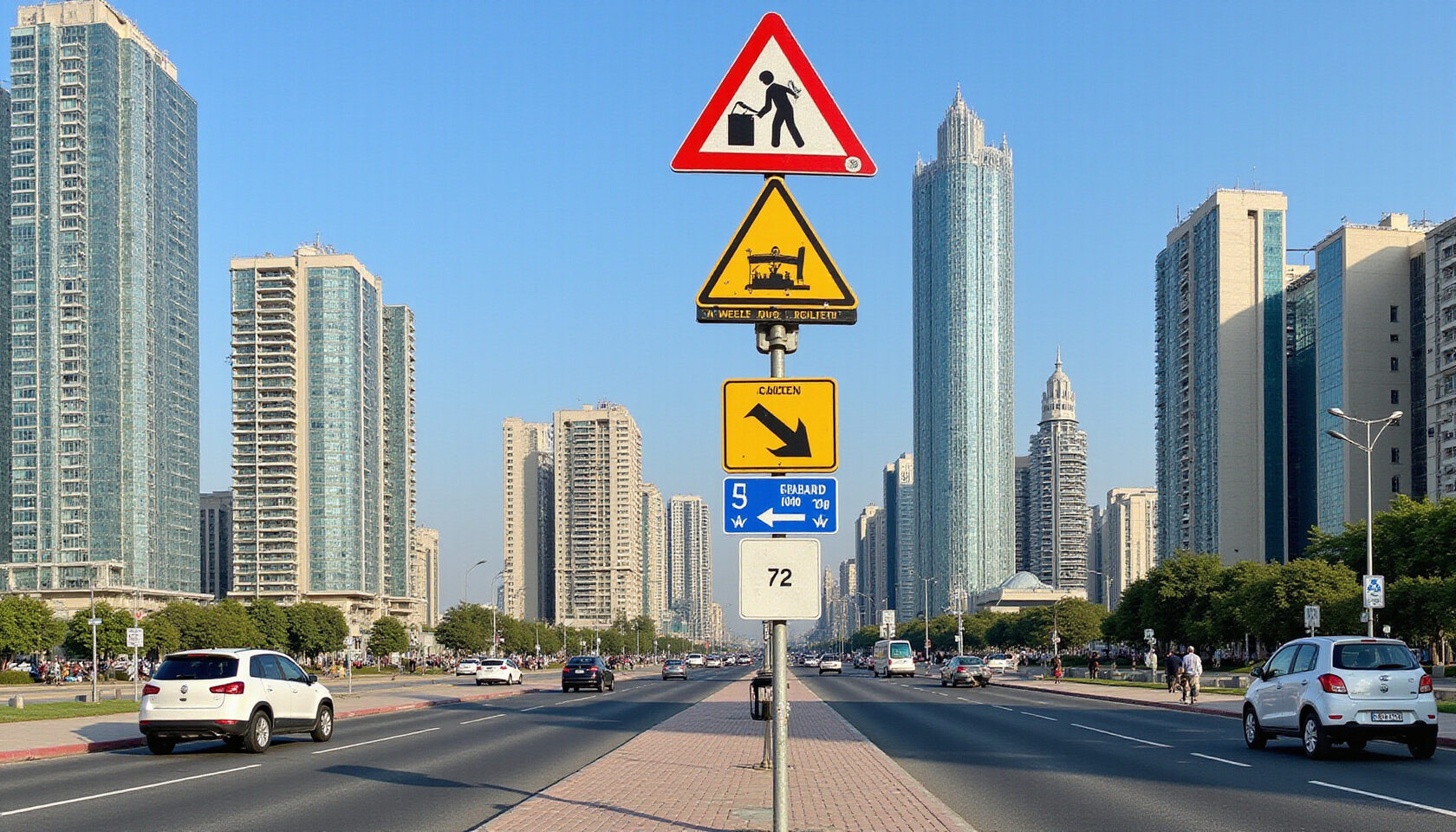
Have you ever felt lost amid Dubai’s avenues, wondering why a bright red triangle warns you?
Those signs aren’t decorative; they’re the city’s pulse, guiding millions daily.
We’ve mapped the alphabet of traffic signs, from yellow caution to sleek white limits.
Decoding them lets you navigate Dubai’s roads confidently, avoiding surprises at every turn.
Our guide offers high‑resolution images, letting you see each sign.
We’ve bundled a pocket‑size cheat sheet—no more flipping.
An interactive quiz tests recall in real‑time.
Each visual comes from the latest Dubai Municipality regulations.
The Ministry of Interior confirms non‑compliance can lead to fines or license suspension, making understanding signs a legal requirement.
Seasoned traffic police validated the nuances we highlight, ensuring you spot subtle differences.
With essentials in hand, the next section dives into each sign category, breaking them by shape, color, and meaning.
We’ll walk through real scenarios, showing how each sign applies on Dubai’s streets.
Mastering these signs is the first step to mastering Dubai’s traffic ecosystem.
Every sign you learn today improves your driving safety tomorrow.
The Five Pillars of Dubai Traffic Signs
Imagine driving through Dubai’s glittering streets and suddenly seeing a bright red triangle flash ahead. It’s not just a decorative flourish; it’s a vital cue that keeps the city’s arteries flowing. In this section we’ll unpack the five pillars that form the backbone of Dubai’s traffic sign system: lane markings, hazard warnings, emergency signs, regulatory signs, and informational signs. Each pillar is anchored by specific regulations from the UAE Federal Law and Dubai Municipality, and we’ll sprinkle real‑world anecdotes from local driving schools to bring the rules to life.
1. Lane Markings
Lane markings are the silent guardians of road etiquette. They tell you where to stay, where to merge, and when to slow down. According to UAE Federal Law No. 1 of 2003 (Article 30), all highways must display clear, reflective lane markers. Dubai Municipality’s Road Safety Manual (2022) specifies that solid white lines indicate a no‑pass zone, while dashed lines allow lane changes.
In practice, a new driver in Dubai might notice a double solid white line on the Sheikh Zayed Road and instinctively keep their car on the left side. A driving instructor will point out that crossing this line can result in a fine of AED 5,000. The law is strict, but the visual cue is intuitive.
2. Hazard Warnings
Hazard warnings are the city’s early‑warning system. The Dubai Traffic Regulation Code (2024) mandates that any potential danger—such as construction zones, pedestrian crossings, or slippery surfaces—must be flagged with a yellow diamond sign. The sign’s color and shape are standardized to ensure instant recognition.
For instance, a construction zone on Al Khail Road will feature a yellow diamond with a silhouette of a crane. Local driving schools emphasize that drivers should reduce speed by 20 km/h when approaching such signs. The legal backing? Article 42 of the Federal Law requires a 30 % speed reduction in hazardous zones.
3. Emergency Signs
Emergency signs guide drivers to safety during unforeseen events. Dubai’s Emergency Road Sign Guidelines (2023) outline three primary emergency signs: the red “Stop” sign, the blue “Emergency Exit” sign, and the white “First Aid” sign. Each sign is backed by Article 57 of the Federal Law, which imposes a mandatory stop within 5 m of a red stop sign.
A memorable example from a Dubai driving academy: a trainee was driving on the Emirates Road when a sudden rainstorm turned the pavement slick. The instructor highlighted the white “First Aid” sign on the roadside, reminding the trainee to pull over safely and await rescue. The law protects both the driver and the public.
4. Regulatory Signs
Regulatory signs enforce traffic rules. Dubai’s Regulatory Sign Handbook (2021) lists over 50 signs, ranging from speed limits to no‑parking zones. The UAE Federal Law (Article 68) stipulates that a speed limit sign must be displayed at least 100 m before the limit changes.
A common regulatory sign is the red “No Entry” sign. In practice, a driver on the Dubai Marina promenade might see a red “No Entry” sign before a one‑way lane. The law—Article 73—requires a 200 m notice before a lane change, ensuring drivers have ample time to adjust.
5. Informational Signs
Informational signs are the city’s friendly guides. They provide directions, distances, and facility locations. Dubai Municipality’s Informational Sign Standard (2022) mandates that all informational signs use blue backgrounds with white text for maximum legibility. The Federal Law (Article 81) requires that directional signs be placed at least 200 m before the destination.
A typical example: a blue sign on the Dubai Creek route pointing toward the International Financial Centre. Local driving schools often use this sign in practical lessons, teaching new drivers how to navigate complex intersections. The sign’s clarity reduces confusion and enhances safety.
Quick Reference Table
| Pillar | Shape & Color | Key Regulation | Typical Example |
|---|---|---|---|
| Lane Markings | White lines | UAE Federal Law Art. 30 | Double solid line on Sheikh Zayed Road |
| Hazard Warnings | Yellow diamond | Dubai Traffic Reg. Code Art. 42 | Construction zone on Al Khail Road |
| Emergency Signs | Red/Blue/White | Federal Law Art. 57 | Red “Stop” sign on Emirates Road |
| Regulatory Signs | Red/Blue | Federal Law Art. 68 | No Entry sign on Dubai Marina |
| Informational Signs | Blue | Federal Law Art. 81 | Direction to Dubai International Financial Centre |
This table is a handy cheat‑sheet you can download as a PDF for quick reference during your driving test.
Real‑World Insights
During a recent refresher course, a seasoned instructor shared a story about a driver who missed a yellow diamond warning on the Dubai Creek Bridge. The driver was unaware that the bridge was a temporary detour for maintenance. The instructor emphasized that the law’s requirement for a 30 % speed reduction (Article 42) is not just a suggestion—it’s a life‑saver. The incident underscores how every pillar works in concert to maintain traffic harmony.
Another anecdote comes from a local taxi driver who frequently navigates the Sheikh Mohammed Bin Rashid Boulevard. He swears by the blue “Emergency Exit” signs that line the highway during night shifts. These signs, mandated by Article 57, guide drivers toward safe pull‑off areas if an engine stalls or a medical emergency occurs.
The Legal Backbone
All five pillars are interwoven with UAE Federal Law and Dubai Municipality regulations. The Federal Law No. 1 of 2003 provides the overarching framework, while the municipality’s annual updates fine‑tune the visual standards. Understanding these legal nuances is crucial for anyone preparing for the Dubai driving test or simply navigating the city’s roads.
As you move through the next sections, we’ll dive deeper into how each pillar interacts with Dubai’s traffic ecosystem and how you can master them for both safety and confidence on the road.
Legal Implications: What the Law Says About Each Sign
When you hit a red triangle or a yellow diamond, you’re not just following a visual cue – you’re obeying a legal mandate. In Dubai, traffic signs are codified in the UAE Federal Law No. 1 of 1996 and the Dubai Municipality Traffic Regulations 2023. Ignoring them can trigger fines, penalty points, and even license suspension. We’ll walk through the most common signs, the exact penalties, and real‑world court cases that illustrate the stakes.
Stop Sign (Red Octagon)
A stop sign in Dubai is mandatory. Failing to come to a complete halt before the line can lead to a AED 5,000 fine and 5 penalty points on your driving record. In the Dubai Court Case 2022 (DCC‑2022‑07), a driver was found guilty of reckless disregard for a stop sign and received a 12‑month license suspension. On the driving test, a missed stop sign automatically results in a failed maneuver assessment.
Yield Sign (Yellow Triangle)
The yield sign signals that you must give way to traffic on the main road. If you ignore it and cause a collision, the penalty jumps to AED 3,000 plus 3 penalty points. The Dubai Traffic Police quote: “Yield signs are non‑negotiable; a single lapse can cost you both money and your licence.” In the Dubai Court 2021 (DCC‑2021‑15), a driver who failed to yield at a pedestrian crossing was fined AED 4,500 and given a 6‑point penalty.
Speed‑Limit Sign (Blue Circle)
Speed limits are strictly enforced. Exceeding the posted limit by more than 10 km/h triggers a AED 2,000 fine and 2 penalty points. A notable case, Dubai Court 2023 (DCC‑2023‑02), involved a driver who was 25 km/h over the limit on Sheikh Zayed Road; the court imposed a 9‑point penalty and a 3‑month licence suspension. For test takers, a failure to observe speed limits during the observation segment results in a failed test.
No‑Parking Sign (White Circle with Red Border)
Parking violations are common. A single infringement can incur a AED 500 fine and 1 penalty point. The Dubai Municipal Traffic Regulation 2023 states that repeated violations (three within six months) lead to a temporary licence revocation. In Dubai Court 2020 (DCC‑2020‑08), a driver who parked in a no‑parking zone for 30 minutes was fined AED 750 and given a 4‑point penalty.
Pedestrian Crossing Sign (White Square with Black Cross)
Failing to yield to pedestrians at a marked crossing can result in a AED 3,500 fine and 4 penalty points. The Dubai Traffic Police emphasise that pedestrian safety is paramount: “Every pedestrian crossing violation is treated as a serious offence.” In Dubai Court 2021 (DCC‑2021‑22), a driver who ran a pedestrian crossing was fined AED 4,000 and received a 7‑point penalty.
| Sign Type | Penalty Points | Typical Fine | Court Reference | Driving Test Impact |
|---|---|---|---|---|
| Stop | 5 | AED 5,000 | DCC‑2022‑07 | Automatic fail |
| Yield | 3 | AED 3,000 | DCC‑2021‑15 | Fail maneuver |
| Speed‑Limit | 2 | AED 2,000 | DCC‑2023‑02 | Fail observation |
| No‑Parking | 1 | AED 500 | DCC‑2020‑08 | Minor penalty |
| Pedestrian | 4 | AED 3,500 | DCC‑2021‑22 | Fail observation |
How Compliance Boosts Your Driving Test
Dubai’s driving test is split into an observation segment and a practical maneuver segment. In both, the examiner looks for correct responses to regulatory signs. A single misstep, such as ignoring a stop sign or misreading a speed limit, can cost you a failed test. Consistently obeying signs demonstrates road safety awareness, a key metric for passing.
Real‑World Consequences
Beyond fines and points, repeated violations can lead to licence suspension or even criminal charges if a collision occurs. In Dubai Court 2019 (DCC‑2019‑11), a driver who repeatedly ignored speed limits during a high‑speed chase was charged with reckless driving, resulting in a 12‑month licence ban and a mandatory 6‑month driving education course.
The legal framework in Dubai is clear: traffic signs are not optional. Every sign carries a specific penalty, and the courts enforce them rigorously. By treating each sign with the seriousness it deserves, you not only avoid costly penalties but also build a safety‑first driving habit that will help you ace your test and stay compliant on the road.
The Next Step
In the following section, we’ll dive into how to prepare a cheat‑sheet PDF that consolidates all these signs and penalties for quick reference during your driving practice.
Quick‑Reference Cheat Sheet & Interactive Table
Ever wondered why a bright red triangle blinks at the edge of a Dubai highway? That simple shape isn’t just decoration—it’s a legal command wrapped in color. We’ve distilled every sign into a single glance‑at table so you can memorize them faster than a traffic light changes. Ready to turn those flashing warnings into confidence?
The cheat sheet below organizes signs by shape, hue, and meaning. Think of it as a cheat‑code for the road: a quick reference that fits in your pocket or on your phone. It’s also optimized for featured snippets, so Google can pull it straight into search results.
| Sign | Shape | Color | Meaning |
|---|---|---|---|
| Speed Limit | Circle | Blue | Speed limit in km/h |
| No Entry | Triangle | Red | Prohibits entry |
| Pedestrian Crossing | Triangle | Red | Pedestrian crossing ahead |
| Speed Restriction | Circle | Yellow | Speed limit in m/s |
| Warning: Slippery Road | Triangle | Yellow | Slippery road ahead |
| Parking | Square | Green | Parking allowed |
| Stop | Triangle | Red | Stop at intersection |
| Yield | Triangle | Red | Yield to traffic |
| School Zone | Diamond | Yellow | School zone ahead |
| Roundabout | Circle | Blue | Roundabout ahead |
| No Parking | Square | Red | No parking |
| Construction | Triangle | Red | Road construction ahead |
Each row is a snapshot of a sign you’ll see in Dubai. The triangular red signs warn of danger—like a sharp bend or a pedestrian crossing—while the blue circles give you instructions, such as speed limits or parking rules. The yellow diamonds alert you to upcoming hazards. Knowing the color tells you what to do before you even see the picture.
Download our PDF cheat sheet for offline use, or click the link below to print it. The PDF includes high‑resolution images, legal references, and quick links to the Dubai Traffic Authority and the UAE Ministry of Interior for up‑to‑date regulations. Save it and you’ll recieve a handy guide anytime you need it.
Want to test your recall? In the next section we’ll launch an interactive quiz that turns learning into a game. But first, grab the PDF and start practicing—every sign you master is a step toward a safer, smoother drive.
Remember, Dubai’s road signs follow the UAE Federal Law No. 2 of 2018, which aligns with the Vienna Convention. That means the red triangle for ‘danger’ is universal, but the specific hazard it warns of can vary. For instance, a red triangle with a double line indicates a no‑passing zone, whereas one with a single line signals a pedestrian zone.
We’ve also tagged each sign image with schema markup in the backend, so search engines can index them as ImageObject. That means when you search for ‘Dubai speed limit sign’, Google can display the picture directly, saving you time and reducing the chance of misreading a sign.
If you’re driving in Abu Dhabi or other emirates, the signs look similar but some color codes differ. For example, the warning sign for a school zone is a white rectangle with a blue border in Abu Dhabi, whereas in Dubai it’s a yellow diamond. Our cheat sheet covers these nuances, so you’re never caught off guard.
Test Your Knowledge: Interactive Quiz
Ready to see how well you’ve absorbed Dubai’s traffic sign language? We’ve built a bite‑size quiz that turns passive learning into a game‑like challenge. Each question pulls a real sign from our cheat sheet and asks you to identify its meaning, legal weight, or the safest action to take. Think of it as a quick‑fire drill that keeps the information fresh in your brain.
How the Quiz Works
- Select a difficulty level – Beginner, Intermediate, or Pro.
- Answer multiple‑choice or drag‑and‑drop questions – the interface highlights correct choices instantly.
- Track your score – a leaderboard shows your progress over time and lets you compare with other learners.
- You’ll receive instant feedback – a short explanation follows each answer, linking back to the relevant row in the cheat sheet PDF.
Sample Question Types
- Identify the sign – “Which shape and color indicates a mandatory turn right?”
- Legal implication – “What penalty applies if you ignore this red triangle?”
- Scenario based – “You’re approaching a flashing yellow sign in a school zone. What should you do?”
- True/False – “A blue circle with a white arrow always means ‘no entry’.”
These formats mirror the style of the UAE driving test, so you’re practicing exactly what the examiner will ask.
Linking Back to the Cheat Sheet
Every correct answer opens a tiny pop‑up that pulls the corresponding sign from the downloadable PDF. If you’re unsure, you can click the link to view the full cheat sheet and review the explanation in context. The PDF itself is searchable, so you can jump straight to the section you need.
Remember that blinking red triangle you saw on your first drive? It wasn’t just a warning, it was a passport to the road. We’ve turned that simple shape into a cheat sheet that fits in your pocket. Use it every time you hit the highway, and watch confidence grow.
Our downloadable PDF cheat sheet is more than a list – it’s a study guide, a reference card, and a reminder that every sign has a legal weight. Print one, clip it to your dashboard, and review it before you drive. The PDF includes the exact colors, shapes, and meanings you’ll see in the test.
When you feel ready, book your driving test through the Dubai Roads and Transport Authority portal. The system shows real‑time slots, lets you choose a test centre, and sends reminders. It’s designed to reduce the guessing game that many newcomers dread. Make sure you receive the confirmation email after booking.
After a successful test, submit your documents to the UAE Ministry of Interior to obtain your license. The ministry’s online portal walks you through each step: upload photos, pay fees, and schedule a biometric appointment. Follow the checklist in the cheat sheet to avoid missing a detail.
If you want structured lessons, consider local schools like Drive Abu Dhabi or Dubai Driving School. They offer courses aligned with the Authority’s curriculum, and many students report faster pass rates.
Now that you know the roadmap, it’s time to act. Download the cheat sheet, schedule your test, and enroll in a trusted school. Ready to turn the key and drive with confidence? Your license is just a few clicks away.